Ava TusekDirector of Operations · Chief of Staff

Where strategy meets the teams who execute it.

I clear the noise so teams can do their best work. I build the systems, gather the data, hold people to what they committed to, and drive the results that follow.

+36%revenue growth in one year
2×net margin
$1.6Mseed round supported
−65%overhead through automation

Experience

Different roles, same job.

Across organizations, my job has been the same: help create the strategy, hold the leader and the team to it, and get them to the goal they wanted.

2024 – 2026

Cloud Medical

Director of Operations

Healthcare · three locations · team of 15

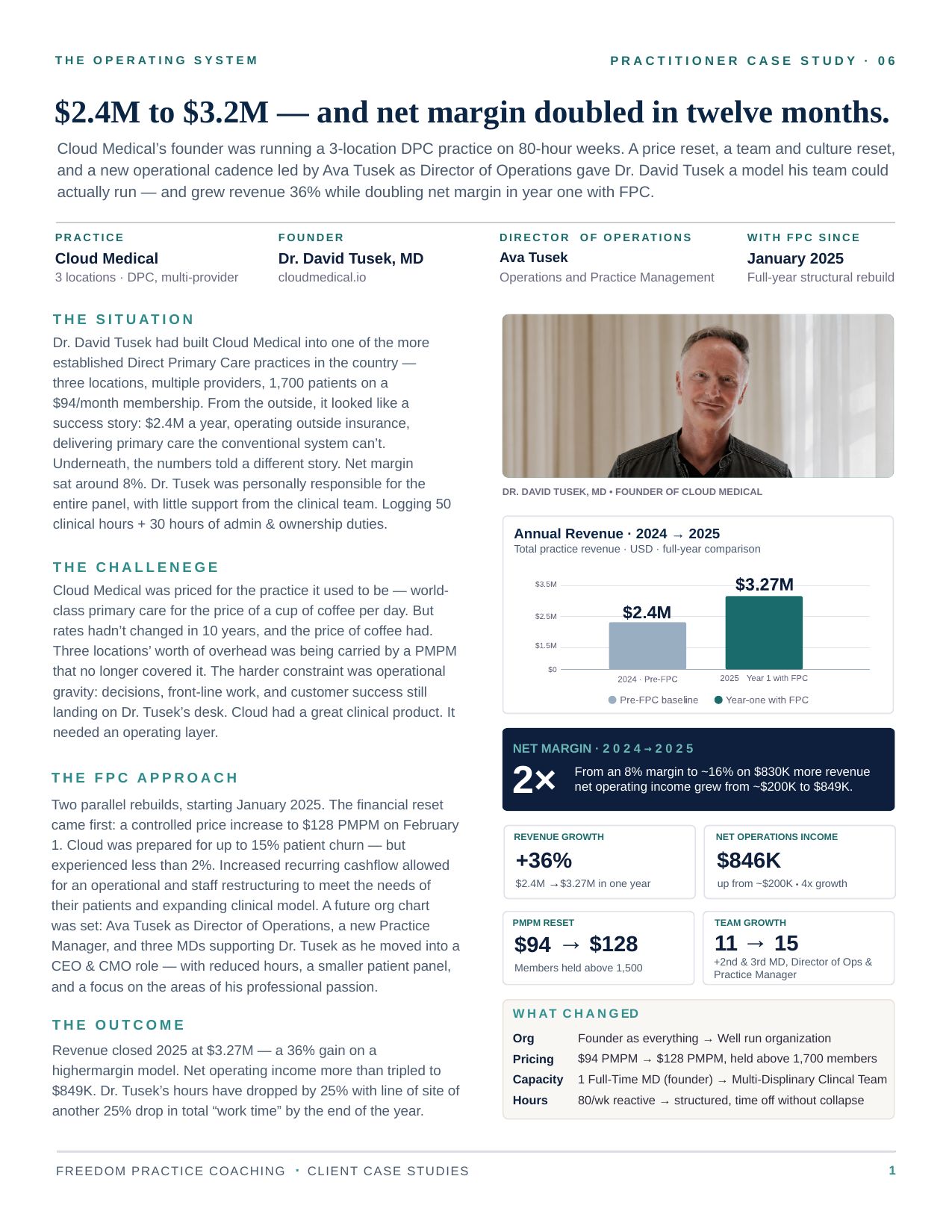
  • Grew revenue 36% to $3.27M and doubled net margin while members went from 1,650 to 1,575.
  • Consolidated six systems into one and built the company's KPIs, first CRM and member lifecycle.
  • Identified, hired, onboarded and managed the team, from performance conversations to promotions.
  • Led change through a 36% price increase with under 2% churn.
  • Launched a monitoring cohort that sold out and brought in $60K, owning pricing, rollout and feedback.
Read the case study →
2022 – 2024

Transmute

Operations Manager · functional Chief of Staff and Client Success

Venture-backed supply chain software

  • Ran the 700+ investor pipeline and diligence behind a $1.6M raise.
  • Cut product and engineering overhead 65% and delivery time about 35%.
  • Point of contact for US DHS/CBP, SAP, Microsoft and CANACERO, with 95% client satisfaction; their feedback drove 65% more UX improvements shipped.
  • Ran three government tech demos and a five-day customer offsite in Monterrey, Mexico, lifting sales close confidence 75%.
  • Rolled out 75+ SOPs, an employee handbook and the platform launch on the SAP Store.
  • Translated executive goals into team processes and kept sales, engineering and the CEO aligned.
2020 – 2022

Rapid Rewire Method

Project Manager

Coaching platform · operations, marketing and customer experience

  • Created and rolled out SOPs across every part of the company: IT, marketing, sales and technology operations.
  • Organized the team's Google Drive, Asana and ClickUp, color-coded, so work was easy to find and track.
  • Managed the experience for 500+ clients across email, social media and Kajabi, and ran live and hybrid events and trainings.
  • Built the CRM and customer journey: onboarding and engagement sequences, funnels and feedback points.
  • Grew social engagement 70% with a new content calendar and wrote email sequences averaging a 22% click rate.
  • Summarized quarterly and annual performance reviews (SWOT, EOS, competitor analysis) and managed volunteer staff.
2016 – 2021

Early career

Independent creator · Assistant event coordinator

Books, community and events, starting at 15

  • Independent creator: started a book-themed Instagram account at 15 and grew it to 50,000 followers, then launched a podcast that reached 30,000 unique listeners.
  • Second Star to the Right Books (2018 – 2021): helped move the bookstore's author events online during the 2020 shutdowns.
  • Ran campaigns that lifted genre fiction sales 1,000% and author events that drew about 75% more attendees.
  • Managed book launches with publishers, staff, vendors and guests, and tracked event and satisfaction data.
More on the About page →

What most organizations are missing

The operational connective tissue.

Most organizations already have the software, the teams and now AI. What they're missing is the person who connects them: someone who uses what already exists to keep people aligned, make the work visible and actually generate results.

My approach

  1. GatherFind the real problem and the data behind it
  2. BriefTurn it into a plan the team, software and AI can act on
  3. BuildPut it in place with the people, software and AI you already have
  4. CoordinateKeep everyone aligned, the work transparent and the results coming

The short version

What I bring, and what I'm looking for.

I'm an operator who makes strategy run: the systems underneath, the teams in the middle and the growth on top.

01

Foundations that hold

I turn scattered tools, data and tribal knowledge into one operating system: clear KPIs, SOPs people use and AI woven into the daily work.

6 systems → 1 · 75+ SOPs · COGS −40%
02

Teams moving in one direction

I translate leadership's goals into work teams can run, and I build agreement across teams I don't manage. Clear communication, steady project management and change people stay for.

Delivery time −35% · <2% churn through a price change
03

Growth that shows up on the P&L

I connect operations to revenue through pricing, partnerships, product launches and customer experience.

Revenue +36% · margin 2× · $60K sold-out launch

Explore My Work

The people side, change, software, KPIs, AI and a full case study. Each one opens right here.

All 13 skills

From core foundations to growth, each with the number and the story behind it

01 · Core foundations

Software implementation6 → 1systems consolidated into one platform
One source of truth for a multi-location team
The story
Challenge
Referrals, labs, prescriptions, billing and customer messages lived in six disconnected tools. Nobody could see churn risk, revenue per customer or real costs.
What I did
Led the migration to a single platform, wrote the rollout plan, trained staff and customers, built message templates, and defined the KPIs and the workflows to track them.
Result
One operating system for the whole team, and real data to make decisions with for the first time.
Systems & AI75+company-wide SOPs rolled out
Processes people actually use
The story
Challenge
Knowledge lived in people's heads, and routine work like message triage, screening and follow-up took hours of staff time.
What I did
Wrote and rolled out 75+ SOPs across sales, HR, marketing and operations. Later built a master SOP with an AI assistant, plus AI agents for message triage, response-time tracking, applicant ranking and customer feedback.
Result
Faster onboarding, consistent answers and hours of repetitive work handed to AI.
Cost discipline−65%product and engineering overhead
Cutting overhead without slowing the team
The story
Challenge
A seed-stage team was paying for redundant tools and losing days to manual contract and expense processes.
What I did
Automated the repetitive steps, removed redundant spend, and templatized contracts and expense reporting. In a later healthcare role, applied the same approach to cost of goods.
Result
Overhead down 65%, contracts signed about 4 days faster, reimbursements about 9 days faster. Cost of goods down 40% in the healthcare role.
Capacity modeling3 → 1independent data sources that pointed to the same answer
Showing a hiring problem was really a model problem
The story
Challenge
The team felt stretched, and the default answer was to hire another combined front desk and membership role.
What I did
Built a capacity analysis from three separate sources: what customers were promised, what they actually used, and appointment and phone data. All three landed on the same ceiling.
Result
Leadership moved from debating a single hire to deciding how the service should be scoped, staffed and priced.

02 · Team alignment

Team building11 → 15team size, including a new manager role
Hiring for the work the business actually needed
The story
Challenge
Roles were fuzzy and work was fragmented, so hires didn't stick and accountability was unclear.
What I did
Pulled data on the work each role needed to do, how long it took and the volume to expect. Then rewrote job descriptions, hired to them, created a new manager role between departments, and built onboarding for each role.
Result
Clear roles, better retention, and a team rebuilt around shared ownership of outcomes.
Cross-team alignment−35%average delivery time for customer contracts
Getting executive goals into the team's daily work
The story
Challenge
Executive priorities weren't reaching the product and engineering team as work they could plan around, and sales and technical teams spoke different languages.
What I did
Translated executive goals into processes the team could run, ran quarterly and annual planning for the executive team, managed communication between the CEO and engineering, and bridged sales and technical teams.
Result
Delivery time dropped about 35% and the sales process got 45% leaner.
Change management<2%churn after a 36% membership price change
A price increase customers stayed for
The story
Challenge
We planned for up to 15% of members to leave when the price went up.
What I did
Aligned the team on one message, gave staff scripts, and made sure the new systems kept the customer experience steady through the change.
Result
Fewer than 2% of members left, and the business gained the cash flow to restructure the team.

03 · Growth

Customer experience95%client satisfaction as point of contact
Closing the loop between customers and builders
The story
Challenge
Enterprise and government customers (US DHS, SAP, Microsoft, CANACERO) needed one reliable contact across sales and engineering.
What I did
Owned customer communication and turned feedback into product changes. Later built an automated feedback loop after every appointment, with personal follow-up on anything under five stars.
Result
95% client satisfaction, 65% more UX improvements shipped from feedback, and lower churn from acting on what customers told us.
Partnerships55%of customers the offering was built for
A partner offering that lowered customers' costs
The story
Challenge
Members were paying for primary care on top of expensive insurance.
What I did
Built a co-branded bundle with an HSA and health-share partner around the core membership. Earlier, managed a platform launch on the SAP Store.
Result
An estimated 30% lower monthly healthcare spend for eligible members, with incentives aligned between customer and company.
Business development+75%increase in sales close confidence
Sales assets and events that moved deals
The story
Challenge
A technical product was hard to explain to buyers at large companies and government agencies.
What I did
Built pitches, collateral and press releases for accounts like FedEx, Microsoft and DHS, ran three government tech demos, and organized a five-day customer offsite in Monterrey, Mexico.
Result
Close confidence up 75% after the offsite and a sales process 45% leaner. In healthcare, a new lab program added about $10K a month at no cost.
Product launch$60Krevenue from a sold-out first cohort
A new program that sold out on launch
The story
Challenge
Members wanted structured support for a specialty therapy, and there was no product built around it.
What I did
Owned pricing strategy, the rollout plan and feedback gathering for a new monitoring cohort.
Result
The cohort sold out immediately and brought in $60K, and member feedback is shaping the next round.
Fundraising$1.6Mraised from a 700+ investor pipeline
Running the pipeline behind a seed round
The story
Challenge
A seed-stage company needed to raise while the executive team kept building.
What I did
Managed the investor funnel, ran diligence and rebuilt the data room with financial models, board minutes and legal documents.
Result
A $1.6M raise and a data room investors could move through quickly.
Revenue growth+36%annual revenue in one year (+$870K)
More revenue from fewer, better-served customers
The story
Challenge
Growth had meant adding members, and the margin sat around 8%.
What I did
Built the foundations and the team first, then grew what each member received: labs, supplements and new plan options alongside the membership.
Result
Revenue grew 36% with fewer members because revenue per member rose about 36%. Net margin doubled.

The people side

Identifying talent, onboarding, managing, and the trials and tribulations

I want people to understand that when they strive to do well, exceed expectations and treat the business like their own responsibility, they win, and they get rewarded.

  • IdentifyDefine the real work of each role from data, then hire to it. An AI workflow ranks applicants from resumes and interview transcripts.
  • OnboardEvery role gets its own onboarding path, with video training and a clear first 90 days.
  • ManageWeekly 1:1s, performance reviews and honest feedback, early rather than late.
  • GrowCoach people toward what they're capable of, and promote them when they get there.

The hard conversations

I've led multiple performance improvement conversations and held people accountable for tardiness, cattiness and sloppy work. Clear expectations and consistent follow-through are kinder than letting things slide.

Over 18 months we rebuilt about 60% of a team around the roles the business actually needed.

Coming back, and moving up

I led a team member's return from maternity leave, then her promotions after it. Along the way I coached her, honestly, on where she wasn't yet meeting her potential.

The role that kept turning over

Rewriting the job description didn't fix it. Rebuilding onboarding and pairing a newer manager with a culture expert and an experienced office manager did. The role stuck.

Asking the team for the right thing

Most leaders don't struggle with ideas. They struggle to ask their team for the right work, in the right order, with the right context. Coordinating people is the hard part, and it's the part I like most.
Change when everyone is maxed out

How I lead change in fast, stretched teams

Change is hardest when everyone is already maxed out. That's also when it matters most.

How I run change in a busy team

  • Explain the why once, clearly, then repeat it in every channel
  • Take work off people's plates before adding new work
  • Give every person a script, a checklist and a date
  • Roll out in stages and fix what breaks in the first week
  • Measure it, so we know the change worked

A price increase members stayed for

We raised membership prices 36% and planned for up to 15% of members to leave. The team was aligned on one message with scripts for every question. Fewer than 2% left.

A new system during a full schedule

We moved a multi-location clinical team from six tools to one platform while patients kept coming in. Staff and patients each got their own training materials, and templates cut the repetitive work on day one.

A new team structure

New roles, new managers and a new org chart, introduced while the business kept running. The goal: every person knows what changed for them and who to go to.

Software implementation

Why core systems still matter, and how I roll them out

AI should enhance your core software, not replace it. At least not yet.

Why we switched the core system

Without a central operating system, nothing else could work: no KPIs, no churn signal, no single view of a customer. Moving six tools into one EMR and patient portal wasn't optional.

AI tools came after, built on top of clean data from that one system.

How I implement software

  • Start from the workflow and the data you need, not the feature list
  • Write the rollout plan and training for each audience
  • Build templates so the new system saves time on day one
  • Set up reporting before launch, not after

What I've rolled out

  • EMR and patient portal: 6 systems into 1
  • The company's first CRM, with discovery-call tracking and email onboarding
  • Lab ordering and results (Fullscript), live in one month
  • Project management in ClickUp
  • A platform launch on the SAP Store

When AI is the right layer

Once the core system is solid, AI earns its place on top: triaging messages, tracking response times, ranking applicants and answering staff questions from the SOP.

Building a KPI system from scratch

Questions → KPIs → data → initiatives, plus the feedback loop

Case study · Building a KPI system from scratch

From "money in, money out" to a scorecard the whole team runs on.

When I joined, leadership could see revenue and expenses and not much else. Here is how I found the questions that mattered, turned them into KPIs, built the systems to measure them, and launched the initiatives that moved them.

1Get there

Start with the questions nobody could answer

I was hired to fix onboarding, so I mapped the customer journey end to end and asked leadership what they wished they knew.

Is this member about to leave? What is a member worth to us? What does it cost to serve them? Are we near capacity?

2Identify

Turn goals into a short list with owners

Each business goal became a KPI with a target, an owner and a source report, split by who acts on it.

ConversionActive customersRevenue per memberChurnCAC & LTV
Response timesDocumentationVisitsNPSReferrals
  • Leadership five say whether the business is healthy.
  • Team KPIs say whether each team's work is on track.
3Measure

Make the data exist before building the dashboard

Most of these numbers couldn't be pulled at all, so the first job was the plumbing.

  • 6 systems → 1 so visits, messages and billing were reportable
  • First CRM so conversion could be tracked at all
  • Data workflows: where it lives, how it's compiled, how it's shown
  • Customer voice: a survey after every visit, plus a quarterly survey
  • AI agent tracking reply times; monthly KPI reporting from a new CFO partner
4Act

Launch initiatives aimed at specific KPIs

Once we could see the numbers, every project had to name the KPI it was meant to move, and we checked whether it did.

  • Ten initiatives, mapped below
  • Results reviewed against targets, not gut feel

Which initiative moved which number

Each initiative was chosen for the KPI it would move. Hover a dot for the detail.

InitiativeConversionActive customersRevenue per memberChurnCAC / LTVCare qualityCapacityResult
Primary targetAlso moved

Spotlight: a feedback loop after every visit

An AI agent sent a short survey after every appointment and routed the answer to the right next step.

Appointment ends→AI agent sends surveyafter every encounter
5 stars across the board→ invited to leave a Google review 4 stars or fewer→ a manager reaches out personally
Quarterly surveychecks the strategy with every member
  • Quick fixesSending doctor bios before every new-patient appointment, straight from what patients told us.
  • Better messagingThe calls showed where our communication had gaps, so we rewrote it for those moments.
  • A seat at the tableThe quarterly survey affirmed our direction and showed members we were listening.
  • The biggest lessonSome customers weren't the right fit for where we were headed. Trying to meet a few high utilizers' expectations was bad for the model, and the data made our target customer clear.

The playbook I bring to any team

Different industry, same order of operations. Find the questions, agree on the numbers, make the data trustworthy, then aim every initiative at one of them.

Question→KPI→Data→Initiative→Review

AI in operations

Agents and workflows I built into daily work

AI in operations

I build AI into the work, not on top of it.

Each of these took repetitive work off the team and gave leadership better signals.

Gemini agent

Patient message triage

Monitored the patient portal, sorted incoming messages by category and generated replies to patients.

Portal message→Categorize→Draft reply
AI agent

Response-time quality checks

Watched reply times in the EMR so we could hold a consistent standard of care in every conversation.

EMR replies→Measure time→Quality review
AI workflow

Applicant ranking

Sorted and ranked applicants using their resumes and interview transcripts, against job descriptions built from real work data.

Resume + transcript→Score→Ranked shortlist
AI assistant

Operations knowledge base

Built on the Master SOP, it answers staff questions about processes, KPIs and vendors so answers stay consistent.

Staff question→Master SOP→Answer

Tools I build with: Claude (Code, Cowork, Design), Gemini (agents, Google Apps Script), ClickUp, HubSpot, Google Workspace.

How I solve problems

Three times the obvious fix wasn't the real one

How I solve problems

The first fix usually isn't the real one.

Three times the obvious answer didn't work, and what I did next.

The hire that wasn't the answer

The problem
The team was stretched thin, and the plan was to hire another combined front desk and membership role.
What I checked
I built a capacity analysis from three separate sources: the visits members were promised, the visits they actually used, and appointment and phone data.
What worked
All three pointed to the same ceiling. The conversation moved from one hire to the real decision: how the membership should be scoped, staffed and priced.

ProvesAnalyticalProblem-solvingInfluence

The CFO partner that didn't fit

The problem
We only had a CPA, with no financial strategist. The fractional CFO group we were referred to produced dashboards that didn't match how we ran the business.
What I tried
We gave it time, but we never built confidence in the numbers. I called it and reopened the search, interviewing more firms against what we actually needed.
What worked
A boutique CFO that fits our model. We now get monthly KPI reporting.

ProvesProblem-solvingAnalytical

The role that kept turning over

The problem
We kept losing people in the same role.
What I tried
I rewrote the job description and changed the interview process. Neither fixed it, because hiring wasn't the problem.
What worked
I rebuilt onboarding from scratch and paired our newer manager with a culture expert and our more experienced office manager for clinical skills and feedback. The role stuck.

ProvesLeadershipProblem-solving

Case study: a multi-location healthcare practice

Revenue +36%, margin 2×, with the full write-up to read

Case study · Cloud Medical · 2024 – 2026

I was hired to fix onboarding. There was nothing to onboard people into.

Cloud Medical is a three-location direct primary care practice. It had a great clinical product, six disconnected systems and no way to see churn risk, revenue per member or real costs. Here is how we rebuilt it from the core out.

$2.4M → $3.27Mannual revenue, +36%
8% → 16%net margin
$121 → $165revenue per member per month
<2%churn after a $94 → $128 price change
−40%cost of goods sold
11 → 15team, with clear roles
  1. Diagnose before designing

    Onboarding couldn't be fixed because there was no member lifecycle underneath it. The business could see money in and money out, and not much else.

  2. One source of truth

    I led the move from six systems to one EMR and patient portal, wrote the rollout plan, trained staff and patients, and defined the KPIs we track. For the first time, we could make decisions from data.

  3. A real member lifecycle

    I launched the company's first CRM, an onboarding email sequence and a Google Ads pipeline, and promoted a team member to own discovery calls. We had conversion data for the first time.

  4. New revenue with less labor

    Moving labs to Fullscript took one month and added about $10K a month at no cost. A white-label plan with HSA for America lowered healthcare costs for 55% of members by an estimated 30%. I also led pricing, rollout and feedback for a new peptide monitoring cohort that sold out and brought in $60K.

  5. The right people in the right roles

    We used system data to define the work each role needed to do, then hired to it: two physicians, an office manager and a new clinical manager role. The team grew from 11 to 15 with shared ownership of outcomes.

  6. Growth that holds

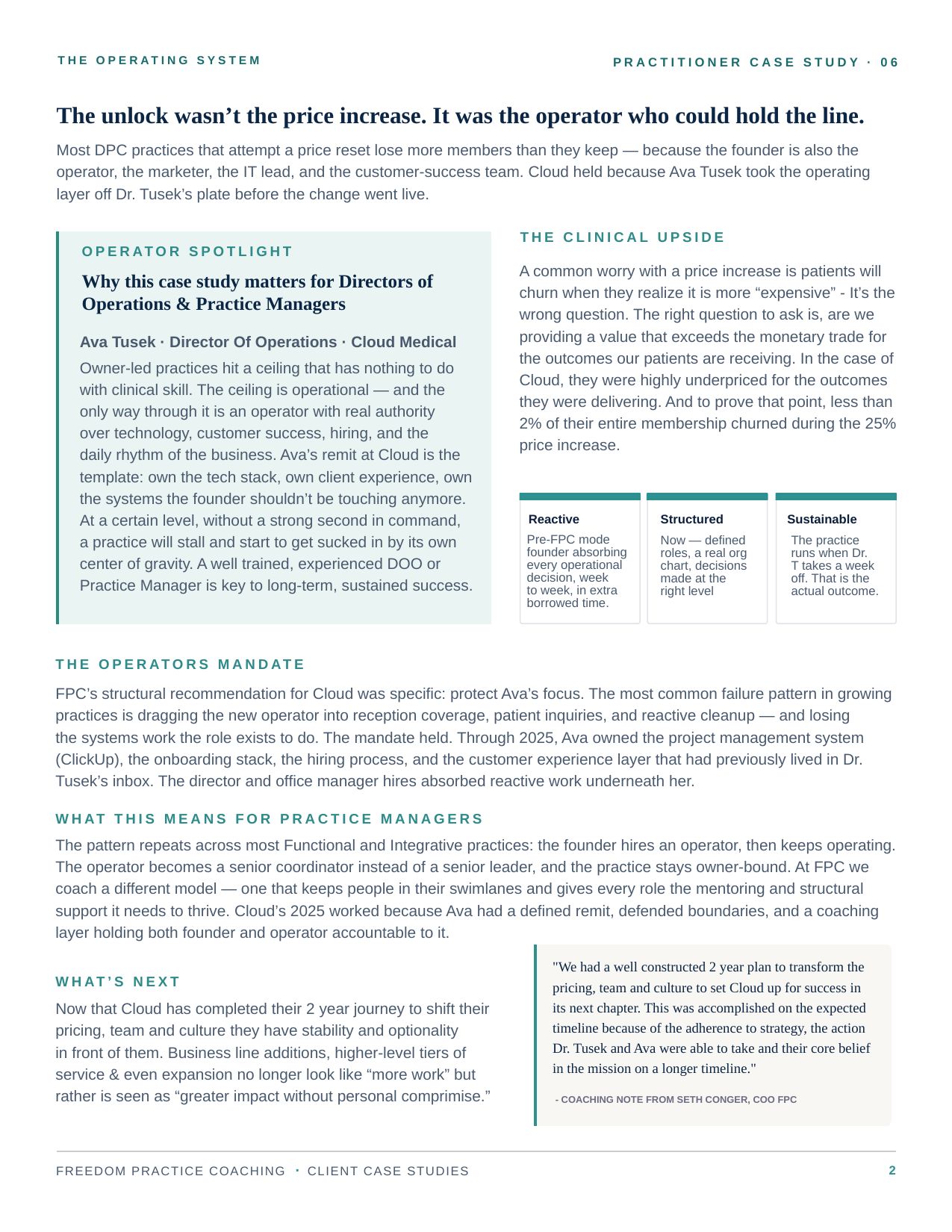
    With the foundations and team in place, a membership price change kept over 98% of members. Revenue grew 36% with fewer members, and the practice now runs when its founder takes a week off.

“We had a well constructed 2 year plan to transform the pricing, team and culture to set Cloud up for success in its next chapter. This was accomplished on the expected timeline because of the adherence to strategy, the action Dr. Tusek and Ava were able to take and their core belief in the mission.”

Seth Conger, COO, Freedom Practice Coaching

Kind words

What the people I've worked with say.

“Initially tasked with administrative and internal processes, she quickly expanded her role to become, functionally, both our Chief of Staff and our Client Success Manager. … What truly sets Ava apart is her people-first mindset. She excelled at bridging communication between technical and sales teams, aligning cross-functional efforts, and fostering a culture of collaboration and trust.”

Karyl FowlerCo-Founder & CEO, Transmute

“We had a well constructed 2 year plan to transform the pricing, team and culture to set Cloud up for success in its next chapter. This was accomplished on the expected timeline because of the adherence to strategy, the action Dr. Tusek and Ava were able to take and their core belief in the mission.”

Seth CongerCOO, Freedom Practice Coaching

For hiring teams

How would we work together?

A two-minute quiz. Tell me about your business and I'll tell you honestly where I'd help, where I'd start, and whether we're a good fit.

  • 8 quick questions, some serious, some less so
  • Your answers stay on this page
  • Text me your results if you'd like to talk

Contact

I'd love to connect.

I'm looking for Director of Operations, Chief of Staff and operations leadership roles with leaders who want to get back to their priorities, at any size of company.

Prefer to copy it?